The poets and the world war: "On the Eastern Front" by Georg Trakl

On the 3rd of November 1914 Georg Trakl died in the hospital of Kraków. He was 27. The last three months of his life overlap with his experience of the First World War. This starts at the end of August 1914 with a long train journey from his hometown, Innsbruck, to Galicia, the far eastern boundary of the Empire. In this area of the front he took his place as pharmacist. The baptism of fire was short yet extremely cruel and ferocious: the Battle of Grodek, one of the stages of the Battle of Galicia. After that he was assigned to assist ninety wounded and almost hopeless soldiers in a barn. It is the beginning of the end: these were probably the moments when he started thinking about suicide. He tried to kill himself during the retreat, but was disarmed. As the Kraków's medical file states, what was not possible during the retreat was possible with cocaine intoxication.

It's the second time we host one of the poems he wrote during his short war time. After "Grodek", the poem that inaugurated this section of World War I Bridges, we would like to host today Im Osten.


ON THE EASTERN FRONT


The winter storm's mad organ playing
is like the Volk's dark fury,
the black-red tidal wave of onslaught,
defoliated stars.

Her features smashed, her arms silver,
night calls to the dying men,
beneath shadows of November's ash,
ghost casualties heave.

A spiky no-man's-land encloses the town.
The moon hunts petrified women
from their blood-spattered doorsteps.
Grey wolves have forced the gates.


(Translation by John Greening)


IM OSTEN


Den wilden Orgeln des Wintersturms
Gleicht des Volkes finstrer Zorn,
Die purpurne Woge der Schlacht,
Entlaubter Sterne.

Mit zerbochnen Brauen, silbernen Armen
Winkt sterbenden Soldaten die Nacht.
Im Schatten der herbstlichen Esche
Seufzen die Geister der Erschlagenen.

Dornige Wildnis umgürtet die Stadt.
Von blutenden Stufen jagt der Mond
Die erschrockenen Frauen.
Wilde Wölfe brachen durchs Tor.

The international conference "Refugees/Asylum-Seekers. The displacement of civilian populations in Europe during the First World War" in Rovereto (Italy)

Serbian refugees
As we all know the theme of refugees and asylum seekers is nowadays a topical issue. We already dedicated an interview to Italian refugees during the First World War (here you can read that interview). But we need to broaden our horizon and this is why it really makes sense to point out the upcoming event of this week. The War Museum in Rovereto (Trentino, Italy) organizes an interesting international conference with the title of "Refugees/Asylum-Seekers. The displacement of civilian populations in Europe during the First World War. The roots of a contemporary problem". The conference will held in Rovereto (Trento province) from 4 to 6 November 2015 in the Conference Room of the MART - Museum of Modern and Contemporary Art.

REFUGEES/ASYLUM-SEEKERS
THE DISPLACEMENT OF CIVILIAN POPULATIONS IN EUROPE DURING THE FIRST WORLD WAR. THE ROOTS OF A CONTEMPORARY PROBLEM

International convention
4-6 November 2015
Rovereto (TN - Italy)

Organized by
Università degli Studi di Trento
Museo Storico  Italiano della Guerra
Fondazione Museo Storico del Trentino
Laboratorio di storia di Rovereto
Accademia Roveretana degli Agiati
Fondazione Bruno Kessler

With the support of
Provincia autonoma di Trento
Comune di Rovereto

During the First World War more than 10 million civilians were forced to leave their homes under army pressure and the threat of bombing. They lived in extreme poverty for years with little legal protection, suffering xenophobia, violence and abuse.
A hundred years after the conflict, the scenario has barely changed. The masses of refugees besieging the borders in our globalised world demonstrate how close wars are and how refugees face extreme conditions that have endured for a century.

These themes will be discussed in an international conference that will take place in Rovereto (province of Trentino, Italy) between 4th and 6th November 2015 (working languages are English and Italian, with simultaneous translation). The conference aims to offer an opportunity to meet historians who have intensively worked on single case studies and share their research results. At the same time, we cannot forget that during the twentieth century till now the civilians have been more and more involved in every kind of conflicts, as is testified by millions of women, children and men gathered in refugee camps all over the world.
The Conference will also offer an opportunity to reflect on the conditions of the refugees along the last century. A particular attention will be focused on the figure of the refugee (in the session held on 6th November), who is, on one side, protected by international agreements, on other side, exposed to constant risks. The complete programme is available at this link.

Beside of that, a new exhibition will start the same days in Palazzo Alberti Poja, inside the civic museum of Rovereto. The title is "The Displaced: Refugees, Flüchtlinge, Uprchlíci 1914-1919". Further information (in English) is available here.

Venue of the conference:
MART Conference Room
Corso Bettini 43
Rovereto - Italy

INFO:
Museo Storico Italiano della Guerra
via Castelbarco 7, Rovereto TN - Italy
+39 0464 438100
comunicazione@museodellaguerra.it
www.museodellaguerra.it

The poets and the world war: "Sumatra" by Miloš Crnjanski

Crnjanski in 1914
Miloš Crnjanski was born in Csongrád (Hungary) in 1893. He moved soon with his family to Timisoara (Romania) and grew up in a Serbian patriotic atmosphere. We can easily figure out that he is under special observation immediately after the Archduke's assassination in Sarajevo. In fact he was initially persecuted but lately sent by the government of Wien to the Galician front, in the summer of 1915. He was forced to leave the comrades for pneumonia and spent quite a long recovery period in the military hospital of Wien. After this time he took his place in the second lines, as telephone operator in a railway station. He published his first anti-war poems in the middle of the European havoc and carnage. In 1917 he attended the school for reservists and was assigned to the supreme command of the Austro-Hungarian army in the Friuli region, precisely in San Vito al Tagliamento (Northeast Italy). He wrote more than one poem dedicated to the experience of war and he also kept diaries (we remember The Diary of Čarnojević). The poem we propose today is not far from resembling the missing manifesto of "Sumatraism" and was written after the war. It's an interesting example of the poetry that was conceived after the disaster, a frequent situation we may find everywhere, with different tones and expressions, in the aftermath. Crnjanski's most renowned and translated work is Migrations ("Seobe"), which is also considered his masterpiece. He died in Belgrade in 1977.


SUMATRA


Now we are carefree, tender and airy.
Let us think: how quiet are, the snowy
peaks of the Urals.

If we get sad over a pale figure,
whom we have lost on some evening,
we know that, somewhere, a rivulet,
instead of it, all in red, is flowing!

One love, morning in foreign land,
envelops our soul, gets tighter,
in endless peace of blue seas,
from which the crimson corals glitter,
like, from my distant homeland, cherries.

We wake up at night, smiling dearly,
to the Moon with its bow bent,
caressing the distant hills, tenderly,
and icy mountains, with our hand.

Belgrade, 1920

(Translation by Lazar Pašćanović, see also here for a French translation)


SUMATRA


Sad smo bezbrižni, laki i nežni.
Pomislimo: kako su tihi, snežni
vrhovi Urala.

Rastuži li nas kakav bledi lik,
što ga izgubismo jedno veče,
znamo da, negde, neki potok
mesto njega teče!

Po jedna ljubav, jutro, u tuđini,
dušu nam uvija, sve tešnje,
beskrajnim mirom plavih mora,
iz kojih crvene zrna korala,
kao, iz zavičaja, trešnje.

Probudimo se noću i smešimo, drago,
na Mesec sa zapetim lukom.
I milujemo daleka brda
i ledenegore, blago, rukom.

Beograd, 1920

Italian Great War Museums #8: Museo storico e naturalistico della Grande Guerra 15-18 in Maserada sul Piave

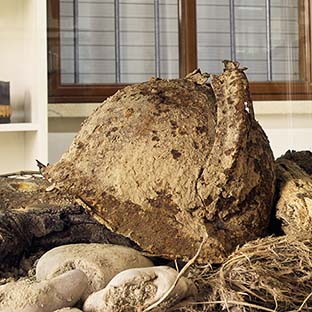
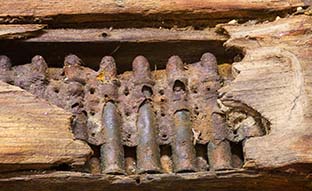
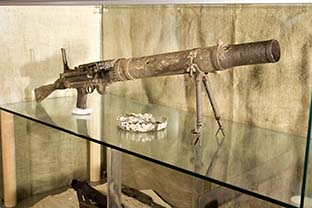
Military units from nations allied with Italy were involved in operations along the River Piave. The British Expeditionary Force played a decisive part in actions during the crucial stages of the final battle, known as “Battaglia di Vittorio Veneto” or “Third Battle of the river Piave”. The Great War Museum of Maserada sul Piave, a municipality lying just in the middle course of the Piave river, between the Montello hill and the river mouth, hosts an interesting collection of relics found in different times from the river banks and surrounding areas, especially after the floods. The collections focus on the history and material relating to troops of the British Seventh Division but visitors can find here a valuable part dedicated to the Austro-Hungarian army and equipment (the below stuff in the pictures was all found on the bed of the river Piave, in the area of a small village called Salettuol).

Italian helmet mod. Adrian
6.5 cartridge set for Italian machine gun mod. Fiat 14
Trunk used to carry cartridges for Schwarzlose machine gun
Sanitary stuff
The light British Lewis machine gun


Info
Museo storico e naturalistico della Grande Guerra 15-18
Viale Caccianiga, 62
Maserada sul Piave - Treviso - Italy
www.museodimaserada.it - info@museodimaserada.it
T. +39 340 1486936 (curator: Giuliano Bottani)

The exhibition "I Romeni e la Grande Guerra" (The Romanians and the Great War) in Cremona

Cremona, Palazzo Comunale
Starting from last Thursday and up to the 25 of October people travelling in Italy, and in particular in the North of the country, will have the chance to visit the exhibition dedicated to Romanian contribution during the Great War years. This event, designed and planned by "Istituto Romeno di Cultura e Ricerca Umanistica di Venezia", "Istituto per la Storia del Risorgimento Italiano di Cremona e Lodi", "Centro Incontri Diplomatici – Cremona, Museo Nazionale di Storia della Romania", "Archivio Nazionale della Romania e l’Università Babeș–Bolyai di Cluj-Napoca" is now hosted in the nice city of Cremona (close to Milan) and displays more than forty boards that frame the conflict of approximately half a million soldiers from Bessarabia, Bukovina, Transylvania and from the Kingdom of Romania (that entered the war in the summer of 1916). Here is a quick overview and recap about Romania during World War I while here is an interesting slideshow about this exhibition.

Info:
"I Romeni e la Grande Guerra" (The Romanians and the Great War)
Palazzo Comunale - Salone degli Alabardieri
Piazza del Comune, 8
Cremona - Italy
8-25 ottobre 2015 - Free entrance
info and booking: mihai.stan@icr.ro

Event in cooperation with "Comune di Cremona" and with the support of "Ambasciata di Romania nella Repubblica Italiana", "Consolato Generale di Romania a Milano", "Regione Lombardia", "Provincia di Cremona" and "Comune di Cremona".

The international conference "Being Young during WW1"

Austro-Hungarian soldier and children, Eastern Front
Although it might seem obvious to write such things, we have to admit that a global war has a different impact depending on gender and age. Not only the soldiers were young during the five years of the Great War and it’s not a coincidence that the most popular title with the word “youth” belongs to a woman, Vera Brittain and her Testament of Youth. The international conference "Being Young during WW1" to be held at Manchester Metropolitan University on 7 November 2015 aims “to examine the effects of the First World War on children and young people, and its social and psychological legacies. Growing up in a period of conflict had an immense impact on the young. There were deep fears and anxieties, but also freedoms and opportunities. For some, the costs were relationships traumatised by separation and the death or injury of family members and friends. For others, school lives were disrupted, adult supervision relaxed and wages rose as a result of labour shortage. Some were caught up in the military excitements of war and enlisted as boy soldiers; others protested and took part in strike action. The image of the child became a potent figure in propaganda and patriotic parades and performances, while war themes became a popular theme in juvenile literature.”

The complete program is available at this link as PDF.

Italy in the First World War: the upcoming conference by the Association for the Study of Modern Italy (ASMI)

As we read in the programme here, "to mark the centenary of Italy’s entry into the First World War, the Association for the Study of Modern Italy (ASMI), in conjunction with Italian Studies at Oxford, is holding a one-day international conference to examine the experience of 1915-18 from a variety of perspectives: military, social, political, cultural and comparative." The conference is open to all and will be held at the Taylorian Institute, University of Oxford, on Saturday 10 October 2015. In the panel we read also the name of Mark Thompspon, author of the essential study on the Italian "white war" on the Alps (The White War. Life and Death on the Italian Front 1915-1918, at this link to The Guardian's website you can find a thorough review of the book). For those who might be interested in the conference, the full address is Taylor Institution, room 2 University of Oxford St Giles’ Oxford OX1 3NA. Info: asmi.events@gmail.com

The 34th edition of the Silent Movie Festival in Pordenone and the Italian war film "Maciste alpino"

Maciste alpino, Italian movie, 1916
Here is only a quick reminder of the 34th edition of the Silent Movie Festival in Pordenone. You can read the program of this year edition here. Thanks to the long dedication of Cineteca del Friuli to the World War One years, people will have the chance to watch here the 1916 Italian war movie Maciste alpino. It also makes sense to remember that Friuli is the Italian region that suffered from the highest impact during the Great War years and a trip to Friuli always turns into a trip in a wide, crucial battlefield of the eastern front. Here is the PDF grid with the festival program that is not fully devoted to Great War films. Anyway, the mix between Friuli and a part of this program is for sure a good reason to organize a trip there for all people interested in World War One. So if you're travelling in the northeastern part of Italy between the 3rd and the 10th of October you may take into consideration a stop in Pordenone, for this excellent festival directed by David Robinson. Out of curiosity only some notes to finish with the popular Italian word "Maciste", still today in our dictionary: it stands for an extraordinary strong and muscular man and it is a neologism by Gabriele D'Annunzio.

Le Giornate del cinema muto / Silent Movie Festival
34th edition
Pordenone, Italy
3-10 October 2015

Here below is a video with an interview about the restoration of the film Maciste alpino, unluckily available only in Italian.

The poets and the world war: "Lust" by Massimo Bontempelli

Massimo Bontempelli (1878 - 1960)
Here and there the following poem could remind us James Hillman's A Terrible Love of War. Probably no one would read and propose these verses in today Centenary atmosphere. It's better to anticipate one thing that the reader will discover in this translation of Lust by Massimo Bontempelli: this is not "politically correct poetry", since it shows hate, disgust, contempt, even gratification after the enemy's death (the title itself is quite strange for a war poem). The magnifying glass is of course on the word "porci" (swines) used to describe the Germans in the trenches. Nevertheless, if we read carefully all the poem, we can notice how the description of the war life that the poet gives us from his side is exactly similar to the typical swines' life and behaviour, under an ethology standpoint (see the mud, the smell, the shit, the mud in the mouth). Perhaps the question is not if are allowed to apply the "politically correct" category to poetry in general. Anyway, as for World War One poetry, we have to admit that today we tend to clean up our memory and prefer the pacifistic poems or at least the brutally realistic ones. Sometimes we probably read the famous Futurist praise of the war as "only hygiene of the world" (and Bontempelli was connected with Futurism) with an unresolved smile on our faces: after all - we might conclude one hundred years later - it was Futurism with its weird guys. We agree that they made a necessary cultural operation, a kind of "global update" of arts, but at the end of the day, to our eyes, they probably remain "those funny futurist guys". It's a joke of destiny and time but isn't it like this? All avant-gardes have a matter to settle with time and they always wage war on time.

But what if we go beyond that praise of war and we imagine the deepest shock that the conflict, together with alcohol, violence and degeneration of humanity can produce on a soldier? Once the necessary distinctions have been made, we could say that like the Second World War had its Céline, the Italian poetry of the First World War found in Massimo Bontempelli a testimony of an ambiguous, contradictory and masochist "sentiment of war". There is no heroism, no salvation for the mankind in this love declaration poetically addressed to war and death. It's like wallowing in the mud of forgetfulness, running over self and time to erase self and time simoultaneously in a sort of cruel sex act (even if this is also a poem of memories, see the beginning where the violent part is probably impersonated by a woman). The poem belongs to the book entitled Il purosangue. L'ubriaco ("The Thoroughbred. The Drunk", 1919), a title that casts light on the well-known scenario of use of alcohol among soldiers, especially before the attacks. It was the only poetry book by Bontempelli, whose legacy is more on the fiction and drama sides. In 1933 Massimo Bontempelli released a second edition of his poems: the new title was shortened to "The Thoroughbred" (Il purosangue, Milano, Edizioni La Prora, 1933) and the poem "Lust" was eliminated. Titles - as well as "director's cuts" - speak to us.


LUST


Smell of trench
  smell
  smell
  of used corpse shit mud
  memories
  do you remember
  when coming in
  you wrapped my neck with your arms
  and I bent under the hug
  wallowing on the latticework
  fighting with force
  before loving you?
 
The nausea enters from the mouth
  and goes down to the heart
  squeezing crushing fermenting
  now, while I go on the hit latticeworks
  under the yelping trajectories
  with bowed head.

But the nausea becomes must and wine
  in the emptiness of the heart.

And that gets drunk by the smell
  smell
  smell of trench.
  It provokes joy.
  Joy of walking
  walking
  walking in this rot
  of being pelted with stones
  by the noise of shells
  of getting lost
  on the right and left
  fifty times
  and standing up with mud in mouth

to get there and see
  the German flesh fall,
  collapsing with head down
  swines bagged
  in the guts of the blue coats.


LUSSURIA


Odore del camminamento
  odore
  odore
  di cadavere usato merda fango
  ricordi
  ricordi
  quando all’entrare
  tu mi buttavi le braccia al collo
  io sguazzando sul graticcio
  mi piegavo sotto l’abbraccio
  lottavo di forza con te
  prima di amarti?

Entra la nausea per la bocca
  scende al cuore
  si pigia si pesta fermenta
  mentre vo sui graticci sbattuti
  sotto le traiettorie che guaiscono
  a capo chino.

Ma la nausea si fa mosto e vino
  nel vuoto del cuore.

Lo ubriaca l’odore
  odore
  odore del camminamento.
  Vi aizza la gioia.
  Gioia di camminare
  camminare
  camminare nel putridume
  d’esser presi a sassate
  dal rumore delle granate
  di perdersi
  a destra e sinistra
  cinquanta volte
  e inciampare abbracciati all’odore
  cinquanta volte
  e rialzarsi col fango in bocca

per arrivare a vedere
  la carne tedesca cadere
  afflosciati testa in giú
  porci insaccati
  nel budellame dei cappotti blu.


(from Massimo Bontempelli, Il purosangue. L'ubriaco, Milano, Facchi, 1919)

"The Major Battles of 1916", international conference and call for papers

Ruins in Verdun, 1916
We would like to thank Alexandre Lafon (Conseiller pour l’action pédagogique - Mission du centenaire de la Première Guerre mondiale) for sharing and allowing us to post the table of contents of the following conference and call for papers: it's all about a central topic of the central year of the First World War.


The French Commission for the Centenary of the Great War, 1914-1918 (Mission du centenaire de la Première Guerre mondiale) and its Scientific Council are organizing an international conference in Paris, 22, 23 and 24 of June 2016 on the subject of “The Major Battles of 1916.”

Problematic

The commemoration of the battles of 1916 runs the risk of treating the latter as if they are self-evident and thus of reducing them to their purely military aspects, whereas the very use of the term “battle” is anything but self-evident. What Maurice Agulhon described as: “a combined series of assaults, of attempts to break through the front or at least to ‘gnaw away’ at the enemy’s defensive lines and so push back the front” stands in sharp contrast to previous meanings of the term “battle.” Indeed, we might ask what a “battle” is in relation to operations covered by the terms: “war”, “campaign”, “offensive”, “combat” or “front”?

The conference will therefore take the “battles” of 1916 in their international dimensions as its problematic.

Its object is two-fold: first, to advance knowledge by broadening perspectives and introducing international comparison; second, to introduce a broad audience to the approaches that have renewed the history of the battles of 1916 in recent years, notably on fronts other than the western front.

The timeframe is the whole of the year 1916.

The conference will encompass all the major battles, wherever they occurred and whatever their form and nature. This includes naval battles. The three great battles of Verdun, the Somme and the Brusilov offensive in Galicia will naturally occupy a central place. However, the interdependence of these battles and the desire for a comparative approach between different battles and fronts make any narrow definition of the subject impossible.

The conference will be organised around three themes.

Constructing battle

Battle was constructed first in the minds of the actors who conceived it and defined its temporal and spatial dimensions, decided on its organisation and made strategic and tactical choices. Those who took part, from the ordinary soldier to the commanders in chief, also constructed battles on the spot. Witnesses constructed them, too, whether as nurses, journalists or eventually through films. Civilians likewise constructed the battle by “public opinion,” by their prior imagery of battle, by their emotions and through the tales told by the “survivors” of battle. Words were crucial, for they inscribed a new reality in the field of experience, a reality of which by definition there was no prior knowledge.

Finally, battle was constructed retrospectively by the authorities that drew up the list of battles, by eyewitness literature, by histories and by commemorations that ranged from simple reminders to full-blown myths. Narrating battle was at the heart of its construction.

To sum up, the question is how the battle was constructed (or reconstructed):

    By words
    By actors
    By the circulation of information and the tales of “survivors”
    By memory, myths and historiography.

Experiencing battle

The question here is how to reconstruct the experience of the soldiers in a way that sees them as more than suffering victims. This will be addressed by various criteria: the prior experience of combat, the relationship between space and time, the material realities of terrain and weather, the moment of intervention in a battle, bodily experience, the length of time spent in the line. Also important are different possible exits from battle: relief by new units, being taken prisoner (but not the subsequent experience of POWs), evacuation with wounds, refusing to obey orders, desertion and fraternisation.

The experience of battle also encompasses the ideas that soldiers had of themselves and of others (the enemy, their commanders, civilians) in the midst of battle. It will be important to identify battlefield learning as this evolved, i.e. knowledge about weapons and their effects and also about terrain, both by the soldiers but also by the officers (detailed mapping, aerial photography).

Of interest, too, is the place of combat within the battle. Combat evolved from one front to another in relation to changing weapons, tactical ideas, unit organisation and the accumulation of experience. Being in battle does not necessarily mean engaging in combat; conversely, combat is not enough to make a battle.

To sum up: the question here is that of the practices and representations of battle in space and time:

    Space and different bodily experiences
    The experience of space and the question of scale
    The experience of battle in terms of its duration
    The use of weapons: combat within battle and the changes in combat in 1916
    Representations of self and other in battle
    Exiting battle: relief, capture, wounding, desertion, refusal to obey, fraternization.

Supplying battle

Supplying battle is first and foremost a question of men. The manpower crisis is a central subject, with repercussions on military mobilization, the organization of units, command (how many officers in the line had been there since 1914?). It is also an international issue, since allies reinforced each other and transferred troops between fronts and sectors. It also entails the overestimation by each side of its own and enemy losses.

Supply is a matter, too, of feeding the combatants, which was a considerable undertaking, without forgetting their horses (a major source of draft power). Battlefield archaeology has much to teach us in this regard, as does socio-economic history. It is also a question of supplying the matériel (weapons, munitions, aircraft, lorries etc.) required by a battle: logistics was a decisive dimension entailing collaboration between allies that has barely been studied.

Finally, new forms of industrial mobilization raise an even broader question: that of civilians and their mobilization or re-mobilization. Supplying a battle means sustaining morale in the rear as well as on the front.

To sum up: this final theme deals with everything needed to make battle function:

    The manpower crisis and transfers of men and matériel between fronts
    Feeding the soldiers
    Producing matériel
    Ensuring the logistics of battle
    Sustaining or reinforcing morale on the front and at home; re-mobilizations

Organisation

The conference will last three days in late June 2016 and will be held in Paris.

Papers will not be read out by their authors but will be summarized in a report presented by a rapporteur in order to facilitate a broad discussion, during which the authors will be able to express their ideas.

The working languages of the conference will be French, English and German, with simultaneous translation.

Papers in Russian will be accepted.

Proposals for papers must reach the scientific secretariat of the Mission du Centenaire 14-18, 109 Boulevard Malesherbes, 75008 PARIS, (alexandre.lafon@centenaire.org) before 1st December 2015. They should consist of an outline of not more than 1,000 words.

The Scientific Council will examine the proposals. Those selected must be received in full by the end of March 2016, in order to allow for their translation into French where necessary and for the rapporteurs to draft their reports.

In addition to the regular sessions consisting of the rapporteurs’ presentation of the papers followed by the general discussion, there will be three or four keynote speeches, including one each to open and close the conference. It is also hoped that at the end of the conference two daylong (but mutually exclusive) battlefield visits will be organized, one to Verdun, the other to the Somme.

An interview with Tim Kendall about the poetry of the First World War


With great and real pleasure we introduce today interview dedicated once again to the poetry of World War One. This time we tried to enlarge our view, to other literatures and to novelists as well. This was possible thanks to the kindness and competence of Tim Kendall, poet, editor and professor at University of Exeter. Among his publications, we would like to remind Poetry of the First World War: An Anthology (Oxford, 2013), The Oxford Handbook of British and Irish War Poetry (Oxford University Press, 2007), Modern English War Poetry (Oxford University Press, 2006). The so called "war poetry" is probably the biggest part of his researches, but it's opportune to recall also his studies on Paul Muldoon (Paul Muldoon, Liverpool University Press, 2004 and Paul Muldoon, Seren Books/Poetry Wales Pr Ltd, 1996) and Sylvia Plath (Sylvia Plath: A Critical Study, Faber and Faber, 2001).

Wilfred Owen
Q: Let's start with the definition of "War poetry". As far as I know the English literature is only literature that "isolated" and grouped some texts under a similar strong "label", even if all countries developed their own war literature and poetry. Do you have a similar opinion and, if so, why do you think this happened? Was there at that time a kind of awareness of being a "war poet"?
A: The term ‘war poetry’ is an oxymoron: destruction and creation, ugliness and beauty. But, of course, war has been the subject of poetry as far back as we can trace. What made England different, in 1914, was the sense that poetry spoke urgently to our national identity. We were the nation of Shakespeare, of Henry V at Agincourt, and our civilisation was bound up with our literature: the greater the literature, the greater the civilisation. After all, we weren’t going to beat the Germans at music or fine art. So, to write a poem was, in some small way, to assert the very values which were under attack. Wilfred Owen told his mother that the only thing which would hold him together on a battlefield was the thought that he was defending the language in which Keats wrote.

Q: A conspicuous part of your studies and research is dedicated to First World World poetry. What brought you to these researches and could you illustrate your last book on this theme?
A: I was tutored by Jon Stallworthy at university. Jon was an immensely generous as well as a brilliant man, and he taught me to love war poetry. My latest book, Poetry of the First World War, is dedicated to Jon, who was the inspiration for so much of my work. 


Siegfried Sassoon
Q: Is there a particular initiative about war poetry (book, conference, event, other) that you want to point out in this "centenary mood"?
A: A great deal of energy was expended in the run-up to the centenary, to ensure that the familiar myths of the war’s futility, of lions led by donkeys, etc., were challenged. But the national curriculum is a rough beast to resist, and Blackadder and Oh! What a Lovely War et al. have ensured that the simple narratives are firmly entrenched. What I’ve most appreciated about the recent treatment of war poetry is an acceptance and appreciation of poets who speak truths to this new kind of power: sometimes, they dare to say, war is enjoyable, enriching, exuberant, as well as dreadful, wasteful, unimaginably brutal. More than that, most of the British poets of 1914-18 believed that the War was necessary. This can come as a surprise to those readers who only knew Owen and Sassoon.


Q: Let's now move to First World World English novelists for a moment. Which are still today the most popular novels and which are the novels that according to your standpoint would deserve a deeper attention (or perhaps a rediscovery)?
A: I’m a Kipling obsessive, and I think that his stories in Debits and Credits and elsewhere stand above any other war fiction that I’ve read. But they’re not novels. Jacob’s Room is the book by Virginia Woolf to which I return. I’m not sure, though, that Kipling or Woolf qualifies as a neglected genius. I would make a special mention of Penelope Farmer’s Charlotte Sometimes, published half a century after the Armistice. That does get overlooked, for no better reason than that it’s commonly classed as a children’s novel. Let me also say that some of the finest prose about the War came from the novelist Mary Borden, who served as a nurse at the Front. The Forbidden Zone is a hybrid masterpiece: memoir, prose poetry, a collection of fragments.


Q:The First World War was paradoxically the last war with a large number of poets, then something has changed in the relation between war and poetry. Do you agree with such statement or do you think it is only an exaggeration?
A: War breeds poets. Every recent conflict provides a cue for the poetasters to wring their hands and indulge their sensitivities. They always want to tell us what we already know --- that war is bad --- but also that they feel this particular truth more acutely than the rest of us. I think of Anthony Hecht’s ‘fierce Strephon’, whose poetry denouncing the Vietnam War brought not only fame but considerable profit: ‘a fate he shared---it bears much thinking on--- / with certain persons at the Pentagon’.


Q: Generally speaking and according to your experiences, what do English students know and study about Italian, French, German, American (etc.) war poets?
A: Generally speaking, absolutely nothing. My own small attempt to improve the situation is to promote the work of the entirely unknown American poet John Allan Wyeth, whose sonnet sequence This Man’s Army is the great forgotten book of the War.


Keith Douglas
Q: I would love to end this interview with your personal choice, namely a poem you would like to suggest to our readers. What do you propose us? And why? Thank you.
A The war poem which hurts me every time is Keith Douglas’s ‘Vergissmeinnicht’: a painfully candid account of the mixed emotions (love, pity, hatred, curiosity, pride, shame, even sexual satisfaction) provoked by viewing a dead and decaying enemy. If you want a First World War poem, I’ll return to Wyeth, and his poem ‘Picnic’. Sassoon wrote that ‘The rank stench of their bodies haunts me still’, but that’s mere mood music compared with Wyeth’s account of what the dead smell like: ‘We drove through Bayonvillers---and as we ate / men long since dead reached out and left a smirch / and taste in our throats like gas and rotten jam’. And the nonchalant payoff of his sandwich-munching companion as Wyeth remarks that the corpses ‘smell pretty strong’: ‘I’ll say they do, / but I’m too hungry sir to care a damn.’

The poets and the World War: "The Cenotaph" by Charlotte Mew

Charlotte Mew (1869 - 1928)
The dilemmas of commemoration and memory of grief are not new and you might only think about epic poems to detect their early expressions in poetry. But staying away from poetry for a while and embracing architecture in our speeches, still today we show sometimes a puzzled face in front of the pieces of architecture built to preserve the memory, symbols of a waste of life that is as much colossal as the lost they try to represent. All countries showed in the aftermath different ways to express the worship of war casualties and this fact is somehow visible in a different architecture, that is the most "public" among the arts or at least the one with a highest "pedagogical" impact and effect on population. A cenotaph for example is a structure built to remind of dead people that are buried elsewhere, basically it's an "empty tomb" (the original Greek word stands exactly for this). We could think about cenotaphs as tombs that evoke the presence of unburied soldiers. In Italy, after World War I, the government led by Mussolini started the construction of several ossari, that are enormous cubical blocks of concrete, often built in panoramic (almost spectacular) areas of a given landscape formerly battlefield. The ossari were erected to preserve the bones ("osso" is the Italian word for "bone") of thousands of soldiers and therefore they are not actually "cenotaphs". When reading today's poem proposal by Charlotte Mary Mew, one of the thoughts that comes to mind is that Italy was not a fervid proponent of World War I cenotaphs in the postwar times. While travelling around Italy, you won't find lots of cenotaphs but more often memorials, monuments, many commemorative plaques and the already mentioned ossari, especially in the northeastern regions. Anyway, this is only collateral thinking coming from reading the poem, even if it's once again the proof of the multiple resources coming from poetry. 

The poem below was first issued in 1919. There is a kind of turning point in the verse that says "It is all young life: it must break some women's hearts to see". The strength of the last part is even surprising. The poem offers the real opportunity to read some lines that put our tranquil beliefs about memory, myths and commemoration under a hard test. Once more, here is the chance to return on this "uncomfortable" poet that committed suicide in 1928 by drinking disinfectant during a treatment for her neurasthenia. Her "thorny" literary legacy probably suffers from being a hinge really in between the Victorian age and the new "modern" era. Even after reading "The Cenotaph", we're almost forced to admit that there is no redemption and no regeneration in spring.


THE CENOTAPH


Not yet will those measureless fields be green again
Where only yesterday the wild sweet blood of wonderful youth was shed;
There is a grave whose earth must hold too long, too deep a stain,
Though for ever over it we may speak as proudly as we may tread.
But here, where the watchers by lonely hearths from the 

   thrust of an inward sword have more slowly bled,
We shall build the Cenotaph: Victory, winged, with 

   Peace, winged too, at the column's head.
And over the stairway, at the foot - oh! here, leave 

   desolate, passionate hands to spread
Violets, roses, and laurel with the small sweet twinkling country things
Speaking so wistfully of other Springs
From the little gardens of little places where son or 

   sweetheart was born and bred.
In splendid sleep, with a thousand brothers
                                  To lovers - to mothers
                                  Here, too, lies he:
Under the purple, the green, the red,
It is all young life: it must break some women's hearts to see
Such a brave, gay coverlet to such a bed!
Only, when all is done and said,
God is not mocked and neither are the dead.
For this will stand in our Market-place -
                                   Who'll sell, who'll buy
                                   (Will you or I
Lie each to each with the better grace)?
While looking into every busy whore's and huckster's face
As they drive their bargains, is the Face
Of God: and some young, piteous, murdered face.

Photos of animals in World War One: what about cats?

So far we have collected pictures of pigeons, foxes, camels, elephants, dogs and horses. Some of these animals were essential in the war everyday life while others were not. But what about the most common pet and its presence in World War One? Cats appear in many photos of the war years and below we propose a short selection. Like the case of the French soldier caressing the little fox that we examined months ago, the images of soldiers with cats were fundamentally taken in moments of rest and serenity. Seen as a series, this bunch of popular images casts light on a kind of backstage of the war, feeding a new imagery and iconography that we will find unchanged in many WWII soldiers' pictures.